Sunday, June 19, 2011

Huambo: Getting there

My next trip after Puno was to Huambo, a small village tucked away in the mountains near Colca Canyon, unmentioned in tour books but famous for being the hometown of Frida, one of the original Ñañas I met my first time down to Peru and a dear friend.  Over the years she'd often spoken proudly of her tierra and told me I had to visit one day so I was ready to go when she invited me to accompany her and her sister's family on their trek home for Holy Week. 


I met Frida and her twin sister, Miriam, at the bus station before dawn on Good Friday and we boarded with passengers weighed down by bags of produce and other goods to take home to their families in the mountains.  Two hours later we arrived at the town of Pedregal where Miriam's husband and son were waiting for us at the home of Frida's younger sister Adelaide.  There we also met our trusty steed, a green 1980s Toyota pickup truck which was to take us the four-hour ride to Huambo.  Above, Frida, Gabriel (Miriam's son), Miriam, and Adelaide's two children, Emily and Joel.

Although a bus makes the trip from Pedregal to Huambo once a day, they had decided we would drive ourselves instead so we could stop off where we wanted and have a more tranquilo (calm) trip.  Little did we know...


Above, Nelson gets ready to close the hood after some final tuneups, and below, Miriam waits with little Emily next to Adelaide's house.  The family moved to Pedregal from Lima less than a year ago, so they're still getting accustomed to their new life in the small town.  The woven reeds in the photo are the walls of the house, and the roof is made of the same material.  This type of structure is a common starter house, always with the hopes of moving to more permanent materials like sillar, the volcanic stone common in the area, when enough money is saved up.


An hour later we were off, three of us up front and three nestled into the back of the truck with the provisions we were taking to Frida's parents in Huambo.

The photos below were taken on the first leg of the trip and remind me a lot of the scenery I saw on the bus trip down the coast from Lima in 2006.  The little boxy structures are makeshift homes made from the same material used on Adelaide's house and represent a leap of faith that is still rather unfathomable to me.   While it's not difficult to understand what would send people away from tiny towns with no running water, electricity, medical care and schools in search of a better life, I still struggle to see how such a bleak, seemingly uninhabitable landscape could be a place of hope for a better future for the people who settle there.

Still, the houses made of sillar below with the beginnings of another piled in the foreground show that for some, that hope is not unfounded and progress does come with time. 


The canal in the photo below is another source of hope as it brings water from the mountains near Huambo to make irrigated agriculture possible in the middle of the desert.  I didn't get my camera out in time to capture it, but I was stunned to see stretches of deep, vibrant green in the midst of the dry expanse, and Nelson explained it was the result of this newly available water source.  I don't know how sustainable it is or how people gain access to it, but it certainly brings new possibilities to the area.


Unfortunately, the future wasn't looking quite so bright for our truck and before we'd been on the road an hour we had to stop so Nelson could fiddle with tires that had locked up. Luckily he had a really supportive team of back-seat mechanics to help him out, and we were back on the road again before we'd fallen too far behind schedule.


As we continued towards Huambo, we wound our way around mountains on the dirt road and steadily made our way up...

... which eventually led to two more maintenance stops, each one longer than the last.  Our truck was obviously less than pleased with the direction our trip was taking us.

  
While the stops made us more and more nervous as the day wore on, they did give us a chance to stretch our legs and take in some of the views.


You can see how varied the vegetation and mountains themselves were as we progressed along our route.

What appear to be clouds in the distance in the photo below are actually snow caps of the mountains near Huambo. 


Shadows were getting longer, stress levels were increasing and we were still without cell phone service when we made our fifth stop, 


but Nelson and his endless stores of patience and resourcefulness finally won out and he coaxed the green beast into carrying us up the final ascent then down into Huambo.  We pulled in, tired but victorious, eight hours after we'd begun our journey from Pedregal (and over 12 hours since we'd left Arequipa), and were greeted by the relieved family of Frida who was just getting ready to head out for Good Friday festivities...


Saturday, June 4, 2011

Papas con queso, a la puneña -- Potatoes and cheese, Puno style

Special potatoes had been the Ñañas' request when I asked what they wanted me to bring back for them from Puno, so Alex and I stopped by the local market before leaving town and went from stall to stall asking the caseritas -- an affectionate term used for the ladies who sell their produce in the market -- for recommendations.


There are literally thousands of varieties of potatoes in Peru and the selection in this tiny market alone was a little overwhelming, but eventually we settled on the imilla negra, a small, softer potato with a beautiful purple skin. 

Back at the workshop, the puneñas (women from Puno) of the group approved of our choice and soon had the potatoes boiling away while Andrea cut up the cheese Alex had sent along from La Joya.


No knife to cut the cheese?  No problem.  Always resourceful, Andrea found a clean knitting needle and went to work.   Here, Maria Luz helps herself to a potato while Andrea doles out the cheese. 

Thursday, May 26, 2011

Puno, Day 2: Lake Titicaca

Next morning we were up early again, this time to take a boat tour of Lake Titicaca, which forms part of the border between Peru and Bolivia and has the distinction of being the highest navigable lake in the world at over 12,500 ft.  

Blurry-eyed but raring to go atop our little motor boat with Peruvian flag, Lake Titicaca, and the makings of another beautiful day in the background.

Our first exciting sight of the day was this little island with tepee-like structures which appeared to have been made exclusively for the pigs living there.  Not quite as sophisticated as the cuy bungalows, but still pretty cozy.


The pigs belong to the Uros, descendents of a pre-Incan group of the same name who construct and live on the Los Uros floating islands, for which Lake Titicaca is also famous.  There are over 40 of these islands on the lake, both on the Bolivian and Peruvian sides of the border.

After about an hour on the boat, we landed on one of these islands (Peru side) and our tour guide explained the process of constructing them.  This particular island was home to six families, and each was responsible for bringing one or two blocks of soil one meter deep and about ten square meters around, held together by the roots of totora, a reed native to the area.

These chunks of soil were then pushed together by motor boats, pegged together with eucalyptus stakes, tied up with synthetic rope, and finally -- to my disappointment --  the whole thing was anchored to the bottom of the lake.


Once the base is assembled, another meter of interwoven reeds is placed on top, with new layers added every month or so to compensate for the decomposition of reeds lower down.  Here, Alex tests out the sturdiness of our island.  


Traditionally, the Uros people have lived off the lake, harvesting bird eggs, fishing and collecting reeds and other plants and animal products to trade with other islands and the mainland in a bartering system called trueque. 

Now, however, there is more need and desire for goods which require the exchange of money, which has led many, but not all, islands to open themselves up to tourists -- some offering opportunities to stay overnight in their homes, others simply to stop by and look around and buy handmade crafts -- in order to generate cash-based income.


The woman I appear to be stalking in this photo informed me that their island only accepted tourists on Sunday mornings, and the rest of the week they were free to go about their daily lives.


Motor boats have become a more common on the lake, but traditional canoes like this one still take both tourists and natives of Lake Titicaca from island to island.  The same totora reed used to construct the islands is used to make these boats, and is also a source of food and medicine.  Thus, when the area became a natural reserve 20 years ago, there was some concern about over harvesting.  Most of the threat has passed, though, as young people choose to move to the mainland and demands on the lake's ecosystem decrease. 

Taking a ride on one of the totora boats.  The landmass looming in the background is the island of Taquiles, our next stop...


A natural, non-floating island, Taquiles is the second largest on the Peruvian side of the lake and home to some 2,000 people separated into six communities.


Tourism began making its way onto the island back in the 70s, but most people still support themselves through fishing and agriculture.  Fava beans, wheat, barley and potatoes are all grown in terraces like those pictured above.  Below, the lovely blue flower of a potato plant.

After inhaling the exhaust of combis and taxis in Arequipa for two months (sadly, it's the third most polluted city in Latin America, after Mexico City and Santiago), I couldn't get enough of the fresh air around Puno and tried to soak up as much as I possibly could. 
Our lunch: piping hot quinoa soup with fresh trout or a veggie omelet, traditional dance demonstrations and another gorgeous view.  

After lunch, we stopped by the town square where a community meeting was being held.  The clothing worn by the men and women in the photo is almost identical to that worn by everyone on the island, and the men's hats and belts are woven by the women and carry a great deal of meaning.  For example, the colors and patterns on the hats change as the men get older and marry and are an easy way to tell who's single, while the belts become increasingly intricate the longer a man has been married, since each year his wife weaves him a new one with an additional symbol for some event or person in their shared life.  By the time a man dies, the belt is essentially a history of his entire married life. 

At one point I asked our guide if families from Taquiles intermarry with families from the floating islands, and his answer was that they generally did not, but for a very practical reason: language.  Whereas most of the people on the Uros islands speak Aymara (see previous post), those who live on Taquiles are Quechua speakers, and they are therefore generally unable to communicate with one another. 

After observing the community meeting for a while, we made our way back down the other side of the island to meet our boat, stopping along the way to take more photos of the beautiful lake and sky.


By the time we got back to Puno it was already getting late, so we ran to the bus station and bought tickets for an 8:00 bus to Arequipa (ETA of 2:00 AM Monday morning), stopped by the local market to pick up some specialty potatoes requested by the Ñañas, then made a last stop at a cafe for a final round of hot chocolates before boarding our bus home. 


Later that week after I got back to Arequipa, I was talking to Juana, one of the knitters who I had always thought was from Puno, and I mentioned how much I loved her homeland.  She laughed at that and said she was actually from Espinar (near Cusco), but she loved Puno so much that she considered herself a puneña (native of Puno).  I guess if that's all it takes these days, I'm a puneña as well.

Sunday, May 22, 2011

Puno: Sillustani

Many of the knitting ladies are from the department -- Peru's equivalent of a state -- of Puno, and I finally made it to the capital city (also called Puno) and Lake Titicaca on the southeastern border of Peru the final weekend of March.  Early that Saturday morning, Alex and I packed all of our warmest clothes and boarded a bus for the six-hour ride from Arequipa. When we arrived in Puno late that morning, we were greeted by this lovely view of the city extending up from the shores of the lake to the hills that surround it:


I was actually a little surprised by how beautiful the city was because I had heard some negative reviews of Puno over the years from visitors.  The ladies always insisted it was because of lack of preparation for the cold (most visit in June and July, the dead of winter here) and altitude, and I think they might be right.
In addition to the chilly nights, the city sits at 12,421 feet, which is a good 7,000 + feet higher than Denver, enough to potentially leave you feeling the effects of altitude sickness if you're not acclimated.  I'd already been in Arequipa for about two months at this point so it didn't bother me, but visitors coming from sea level beware: Pack accordingly and try to ease your way up to the altitude by starting with a stepping stone like Arequipa if you can.


First things first, we headed down to the shores of Lake Titicaca so Alex could try the city's famous fresh-caught trout.  He somehow managed to down this fish and accompanying french fries (typical in Peru, the Land of Potatoes) in the ten minutes we had for lunch  before it was time to meet our tour bus.  He wasn't disappointed.


After our quick lunch, we made our way back up the hill and boarded a tour bus that took us to Sillustani, pre-Incan ruins and terraces (below) about 45 minutes outside of town.


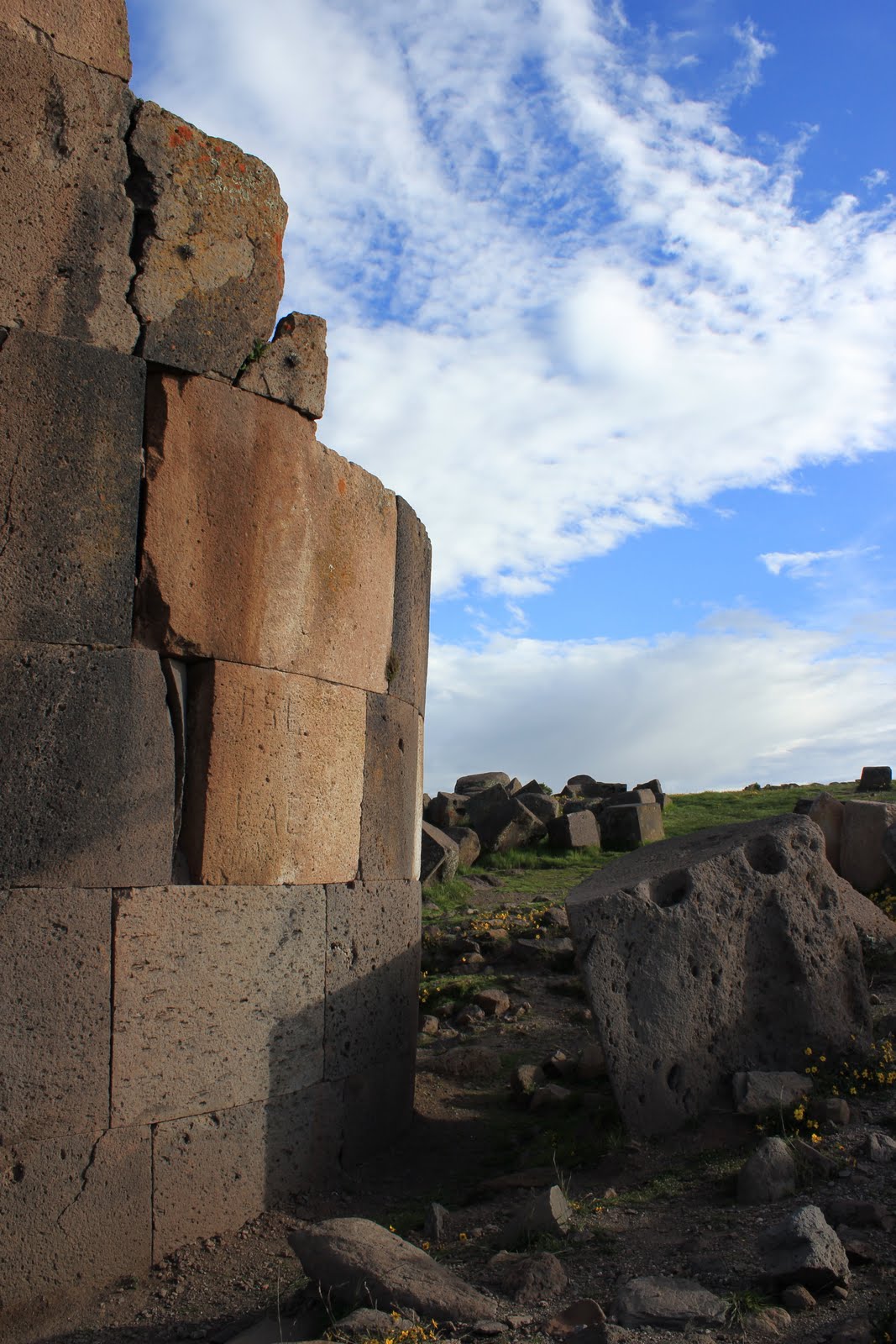
Built to house their mummified dead, the burial towers, or chullpas, were most likely constructed by the Colla, an Aymara-speaking group, in the 1400s before they were conquered by the Incas.  Many of the towers were left unfinished, and others have fallen into disrepair.  Still, you could see the amazing work that has made many call these structures superior to the work of the Incas.


A little background on Aymara: Though it's the mother tongue of fewer than 2% of Peruvians (a number which continues to drop each year), Aymara is still the second most common indigenous language spoken in Peru.  The majority of the world's two million speakers live in Bolivia, but many also live in Puno and in northern Chile.  While most of the women in the workshop speak Quechua, the language used by the Incas, as their first language, Valvina and a few others from the Puno area are Aymara speakers, and it's a very important part of their culture.


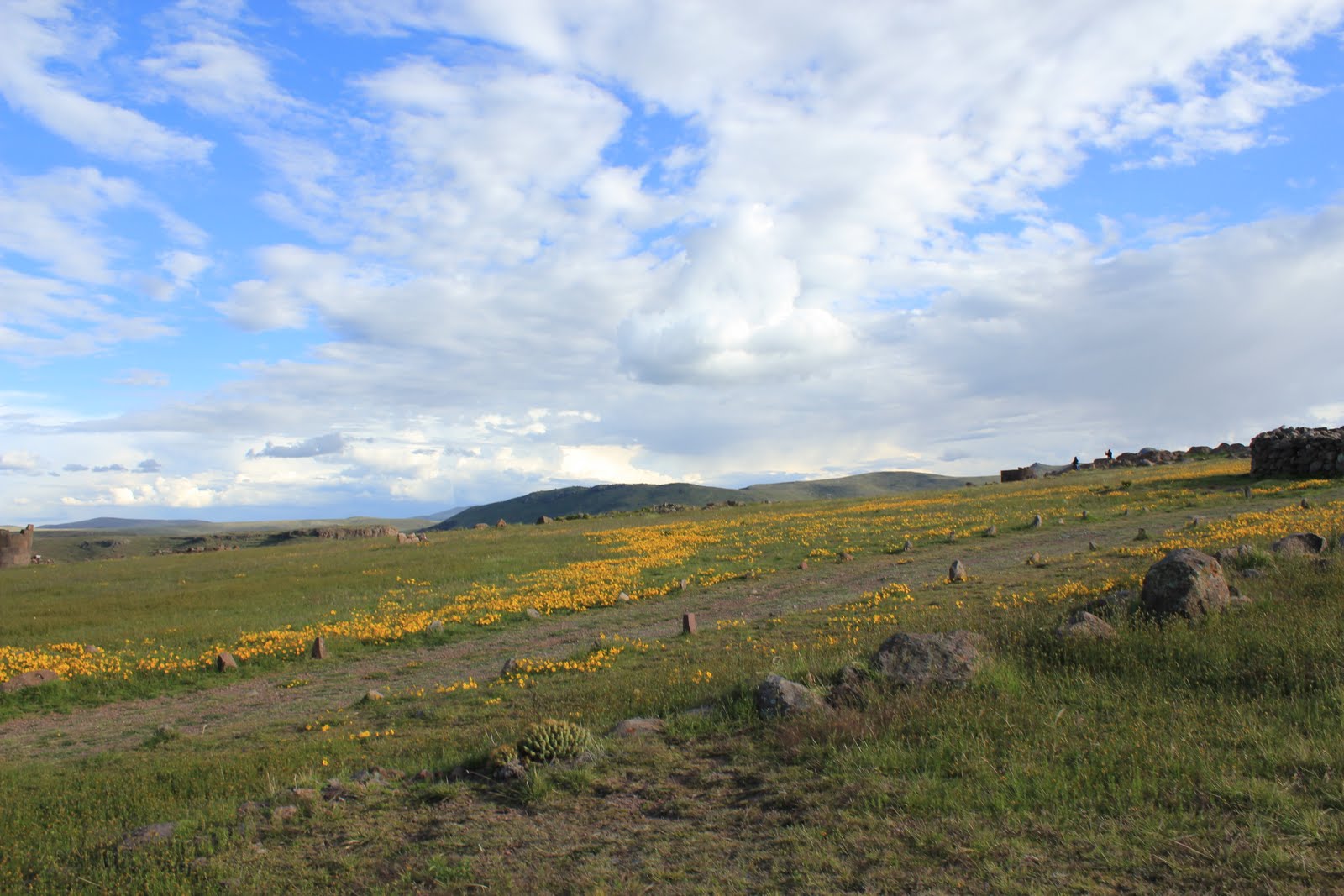
The chullpas were interesting, but as we continued up the hill and the sun began to lower in the sky, we started to get a little distracted by the gorgeous sky and green landscape...

 The view from the top of the hill as we looked down on Lake Umayo was probably the highlight of the day. I had a hard time getting on the tour bus and leaving the breathtaking views and fresh air behind, but the sun was setting quickly and it was starting to get chilly.

On our way back to town, we stopped by a home that was open to tourists so we could see how people live in the area.  I'm generally a little uncomfortable with these home invasions, but I couldn't pass up a photo of this cuy bungalow.  Just tell me those little guys aren't happy.

Another gorgeous sky on our bus ride into town:
Back in town, we found a pizzeria recommended by a friend of Alex's from the area (El Buho) and warmed up over dinner.  Thinking we'd check out Puno's night life, we stopped into a club up the road.  Dancing didn't last long, though, and soon heavy eyes, cold fingers, clumsy hiking boots and the knowledge that another early morning was in store won out and we headed home the for the night...

Sunday, April 10, 2011

Carnaval!

While most of the world had wrapped up carnaval celebrations by the second week of March, we managed to squeeze in two more weekends of cortamontes in Arequipa before the month was up.  This unique Peruvian tradition involves dancing around a tree (typically eucalyptus) decorated with balloons, fruits, blankets, and other gifts, while couples take turns swinging an axe at the tree until it falls to the ground and everyone runs to collect the presents then drag the tree to the house of the person who dealt the final blow -- now the host of the next year's party -- and dance and celebrate until late into the night.

Confused?  I was, too, so I set out to see it in person.  My first cortamonte took place at a soccer court in Andrea's neighborhood in Alto Cayma and was well underway when I arrived.


I wasn't ready to risk committing myself to being the host of the next year's cortamonte, but Andrea and Alex paired up and took their turns, first pouring chicha, the fermented corn drink, on the tree as an offering, then taking a swing or two at the tree before finishing up with a drink of chicha themselves and returning to the circle.  
Andrea's first attempt:
(The woman in pink who offers her chicha was this year's host.)
Then Alex...
Valiant efforts, but the tree still had a long way to go at this point.

One of the fascinating results of urbanization in Peru is the way people and their traditions adapt as they mix with groups from different regions in larger cities like Arequipa. Carnaval is a beautiful example of the hybrid celebrations that result: A blend of traditional dress (green skirt in the left of the photo is from Cuzco, and the other two are from Puno), music and dance from various regions, which are brought together in a strangely urban setting (a soccer court on the edge of town), to create a new kind of tradition.

It definitely becomes trickier to hold your host accountable the next year when it's not simply a member of your town, and many communities end up having to come up with a different host if they aren't able to track down their master of ceremonies.  Still, it doesn't seem all bad when you see proud natives of the region whose music is playing teaching others how to move to the distinctive rhythms and then becoming students themselves for the next round of songs.

In this photo, the man to my right is dancing a traditional dance from Cusco, which Andrea and I tried to figure out without much luck,

while a woman in puneñan clothing works away on the tree in the middle of the circle.  
I needn't have worried about finishing off the tree so early in the game, as it ended up taking another two hours before it went down.  I think everyone was getting a little jealous of this napping baby..

But inevitably, the tree did go down and the boldest onlookers rushed to get their prize.
 Andrea and I were quite proud of our mostly deflated balloon.

The next weekend's cortamonte was held nearby just below the workshop and church, but the presence of more Ñañas (pictured: Paulina, Augustina, Hilaria, me, Andrea, and Sebastiana)...
...a man in a gorilla costume armed with large supplies of pica pica (confetti) and purple talcum powder (Alex got the brunt of it here)...

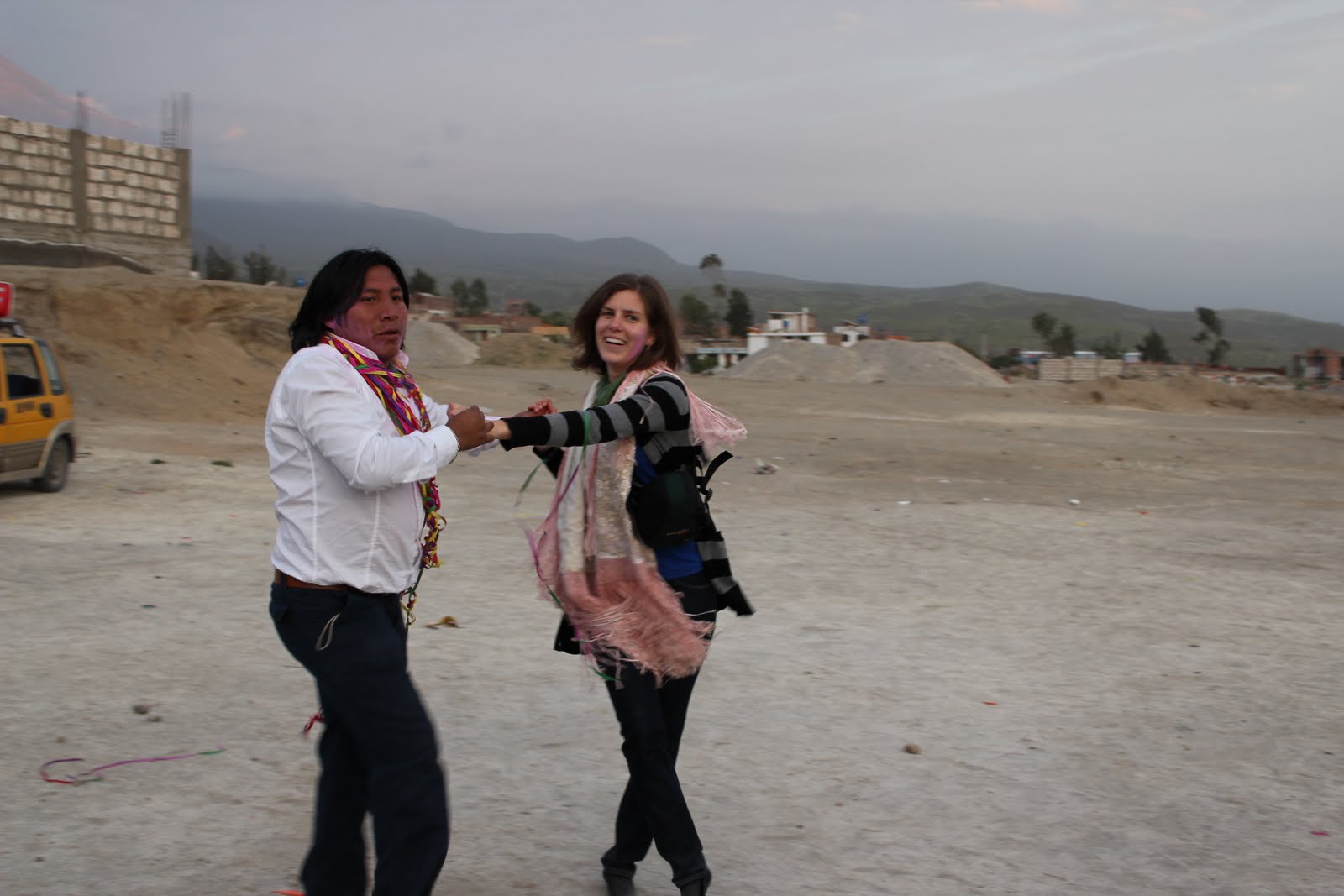
... and some very enthusiastic dancers (new friend Inti pictured below) made for a memorable event. 

Dancing continued long after the tree went down, first following it to the home of the next year's host, then back to Hilaria's, whose mother had hosted this year. 


Final shot of the night: disheveled, tinted purple and covered in confetti, but sad to see Carnaval end. (I am still finding pica pica around my apartment.)